
Routines of morning/evening strolls, play time, and laughter sessions amidst nature resonates a bigger purpose.

During my childhood, playing outside or playing with sand was an added fun element to my day. However, according to a study published in 2017 by Gallup found that children spend an average of 18.6 hours of their free time playing on screens per week compared to 10.6 hours spent playing outside per week.
I was taken aback to witness numerous children immersed in sand play at one of the attractive children’s parks in Bangalore, Nandanavana Park situated in Jayanagar, India. Bangalore, known as the ‘Garden City,’ boasts numerous parks with lush greenery and moderate weather throughout the year.

As I observed, the square shaped park flaunts 14 imported play models safe for toddlers, paved walking track on the borders, massive sculptures of cow, deer, rabbit, dog, along with idols of God – Ganesha, Krishna, Shiva – attracts senior citizens, joggers, pets, and children. A tall, handsome six-year-old boy with a red cap that read boss said, “Park time is the best time in my day. I look forward to meeting my friends and playing with them.”
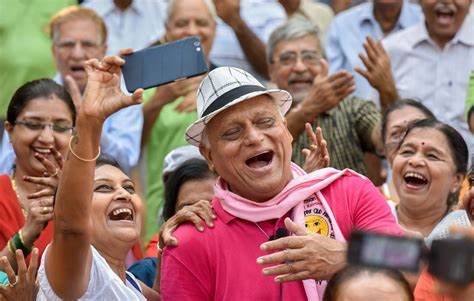
Senior citizens branch out to their respective groups of 5-6 people to take a stroll around the park. If they are interested, they participate in Laughter Clubs either in the morning or evening; usually, standing in a circle formation they perform guided exercises to laugh and release endorphins.

A study published by PubMed Central (archive of biomedical and life sciences journal literature at the U.S. National Institute of Health’s National Library of Medicine) proves that laughter therapy is an important strategy recommended by experts for increasing health promotion in older adults. The study uses controlled sessions of ‘laugh therapy’ – where group participants laugh artificially until the laughter becomes genuine, releasing anti-stress and joyful hormones, and ultimately promoting relaxation.
On the other side, towards a corner, joy oozes out from the faces of 20 – 30 children playing in the sand pit area. They wait for their turns to slide, swing, hang from the bar, and seesaw. A 10-year-old boy named Aveer seemingly looked eldest among all the children. While giving way to 3-year-old Aarya he said, “Though Aarya is not related to me, my mom says to help and look after others, especially younger ones.” According to Dr. Robert Murray, pediatrician and vice chair of the nonprofit Action for Healthy Kids, unstructured time helps kids learn how to self-direct and how to build critical social and emotional skills that will help them interact with others and self-regulate as adults.
Upon asking Sahana – pretty 9 year old girl in her denims and white top with a yellow hairband – her acquaintance with other children, she mentioned, “she moved to the neighborhood three months back, yet she feels she knows other children since a long time.” She gave her hairband to console 1.5-year-old crying baby. In exchange, she received a hug from the baby.
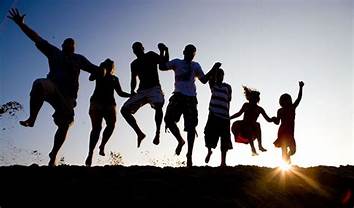
Stress of senior citizens, energy of children, and playfulness of pets is absorbed in the lush greenery of the park. While I sat towards a corner, I could see the park building a community – a bigger purpose. The community remained connected, worked together as a team, cooperated, collaborated, shared and cared for each other.
Sources:
“A Study on Children’s Free Time: How It Is Spent, Prioritized and Valued.” Melissa and Doug, Gallup Inc, August 2017.
Yoshikawa Y, Ohmaki E, Kawahata H, et al. Beneficial effect of laughter therapy on physiological and psychological function in elders. Nurs Open. 2018;6(1):93-99. Published 2018 Jul 18. doi:10.1002/nop2.190

1. “Any activity can be play or not play. The secret sauce is playfulness”
https://www.gse.harvard.edu/news/uk/18/06/summertime-playtime
2. “I first discovered Laughter Yoga at a time in my life when I was searching for connection and meaning in life.” – Judith Croner Small, NZ
https://laughteryoga.org/testimonials/
3. Gratitude – helps people feel connected to a caring community
