
The World Health Organization declared that an ‘infodemic’ was taking place alongside the pandemic, following tragedies such as the 700 people in Iran who reportedly died of methanol poisoning because of misinformation that it could cure the virus. Supposedly there was a simultaneous ‘global epidemic of misinformation’ that ‘poses a serious problem for public health’ and ‘goes faster and further, like the viruses that travel with people go faster and further’.
Disinformation, or false information intended to mislead an audience, has the potential to change public opinion, amplify an issue and change the outcome of political events. In order to fight digital misinformation, we need to understand how false information spreads through the society.
Do you attribute all the blame on social media?
Dr.Colley explains in an op-ed in the Independent, “Disinformation spreads through the interaction of many different information sources, not just social media. For British people, disinformation on social media may not even be the biggest issue. They overwhelmingly distrust social media news and rarely share it. Research shows they see disinformation from politicians and traditional media as more common and concerning.”
Dr. Francesca Granelli, interviewed for the Independent, said: “People are looking for information that reinforces their beliefs. Social media has been the focus [of anti-disinformation campaigns] but it’s not the sole area where people get news—it might be their friends, parents, newspapers, celebrities or musicians.”
A wide range of actors, including politicians, journalists, scientists, social media influencers and ordinary citizens, spread false information. How do we avoid being manipulated and spreading false information? Basic methods of spotting typos, checking for phony web addresses are less efficient. More sophisticated methods of choosing reliable news sources and doing our own fact-check is recommended.
Before you pass on the information, real or fake, pause for a second and ask yourself:
How sure am I about the credibility of the information in order to share it?
The act of verifying what you are reading while you are reading is known as lateral reading. This method helps a person to become the fact checker of the information.
In an NY Times article, ‘How to deal with a crisis of misinformation’, Brian X. Chen tells the reader to pose three questions while reading an article:
- Who is behind the information?
- What is the evidence?
- What do other sources say?
With multiple tabs open in the browser, fact checker reads across the texts in order to evaluate the credibility of the text. After verifying, refuting, or otherwise contextualizing the data in question, you return to the original text and continue reading.
One might argue, lateral reading method calls for multitasking with multiple tabs open and not focusing on one thing at a time. However, critical readers do lateral reading naturally without thinking of it as a ‘strategy.’ For others, as they are still developing their reading muscles, we need to emphasize on practices of ‘good readers’ and hope that they will mimic those efforts themselves.
The book, ‘Web literacy for student fact checkers,’ recommends four moves to get closer to the truth of the information. They are:
- Check for previous work – Check whether someone else has already fact-checked the claim or provided a synthesis of research.
- Go ‘upstream’ to the source – Get to the source of the information to check for credibility or orignality of the information
- Read laterally – Read what other people say about the information.
- Circle back – If you hit dead ends, back up and start over.
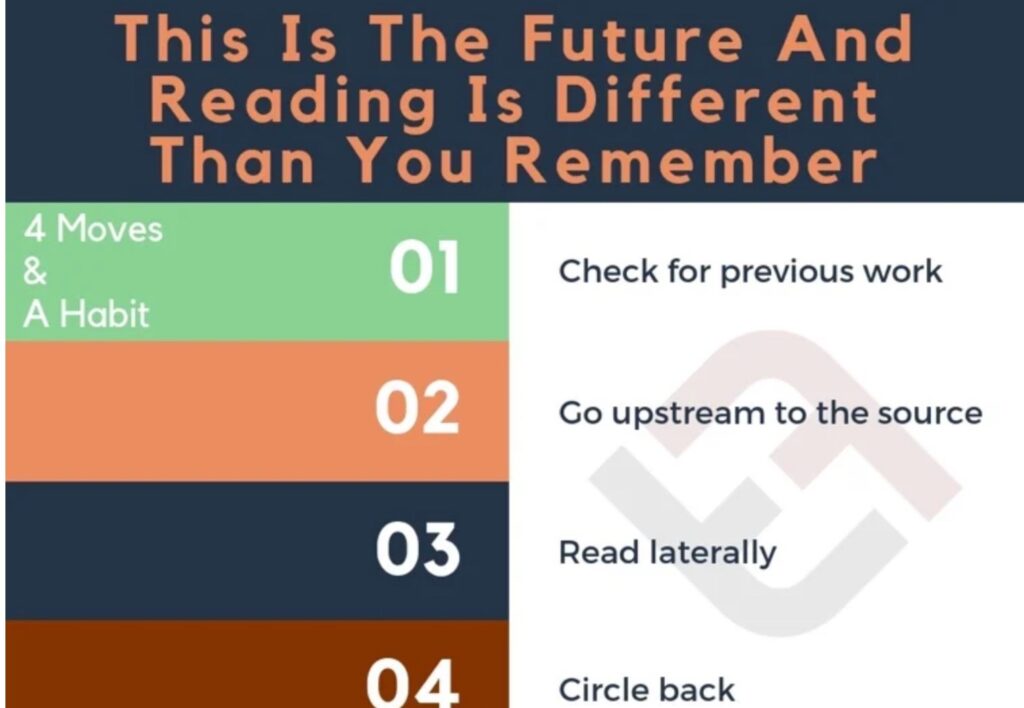
Reading a text in isolation is dangerous. The big idea is to see the text-in-context-as connected to other texts, data sources, readers, publishing platforms, and all of their inherent biases.
This is the future, and the simple, easy reading you remember is gone.
Sources:
1. “Managing the COVID-19 infodemic: Promoting healthy behaviours and mitigating the harm from misinformation and disinformation” 23rd September 2020
2. “We need to look beyond social media to tackle the scourge of disinformation” Thomas Colley, 23rd August 2020
3. “Conservative Party used disinformation ‘with new level of impunity’ during 2019 general election, report finds” Lizzie Dearden, 24th August 2020
4. “How to deal with a crisis of misinformation?”
5. Web literacy for student fact-checkers
